Snooker Practice Policy
The aim of this guidance is to provide support and ideas for players who wish to practice. It is also to ensure that we limit any damage to the cloth, pockets and snooker table markingsand to keep our match tables in excellent condition.
Please ensure before you practice that your tip is in good condition and that the ferrule has no sharp edges. There are several non-marking chalks available on the market and these are encouraged by the club. They leave hardly any chalkresidue or chalk marks on the table as well as reducing poor contact between cueball and object ball.
• When you remove the cover at the beginning of your session, please ensure it is folded lengthways in thirds and then gathered from the baulk cushion towards the top cushion. The cover should be placed in the provided box under the table, so a trip hazard is avoided.
• Put your mobile phone on silent at the start of the practise session and then should you need to use your mobile, leave the snooker room and go outside to the stairwell entrance to talk in privacy.
• This is equally important etiquette on any at any other time when club members are playing snooker.
• Practice is only allowed on table number one, nearest to bar. If another player arrives at the club and wishes to practice, then please limit your practice session to 30 minutes and then vacate and allow them to use the table for 30 minutes. Practising on the match tables 2 and 3 prior to playing a frame should be limited to ten shots or less prior to the frame beginning.
• Vary your practice routines to help avoid wearing the same parts of the table. There are suggested routines below provided by WPBSA, which are by no means comprehensive but address the skills practices required to improve your game. If you want any further advice, then please ask Alan Roll or Steve Paling who are qualified WPBSA snooker coaches.
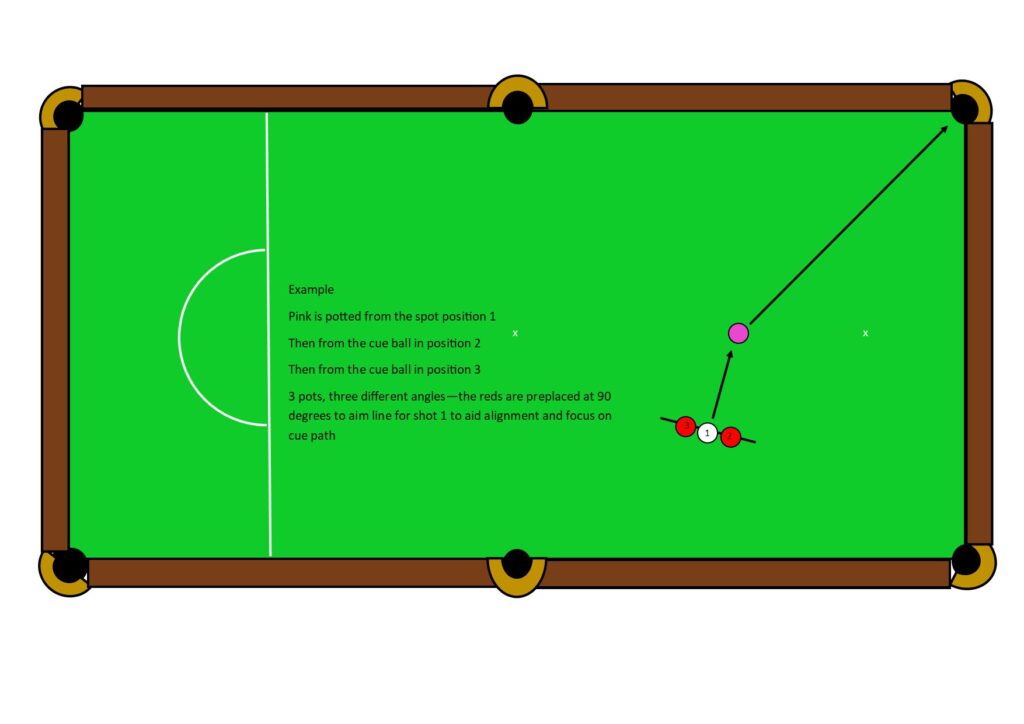
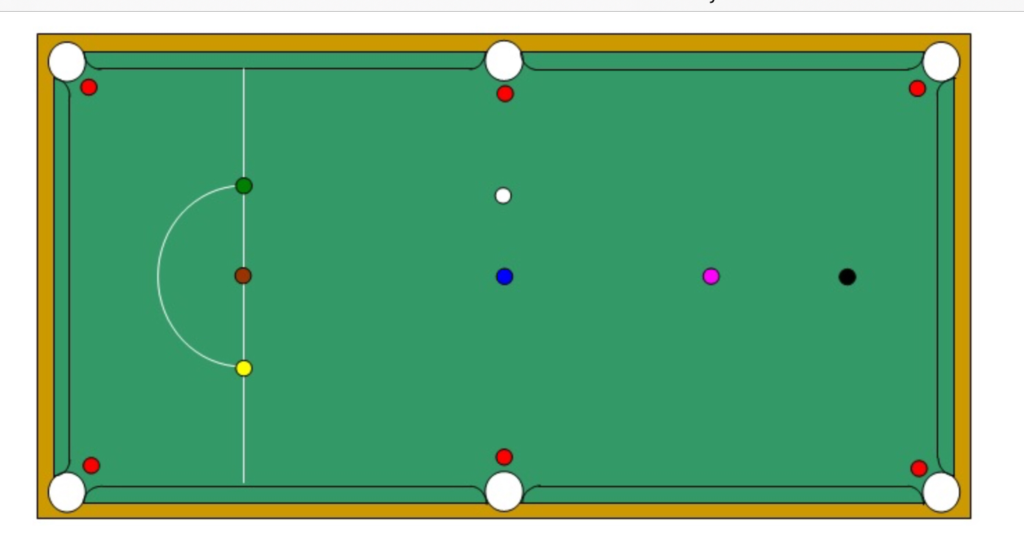
• Avoid playing repetitive shots from the same position, e.g. the spots for the colours. If practising potting the colours, then limit this to 6 shots from a variety of angles. Please see the recommended three shot routine included in the coaching diagrams. Repetitive shots from the same colour spot will wear the spot as the ball is replaced each time and creates a burn line on the cloth which cannot be brushed out. We need to avoid these recurring lines, so similarly if you miss a pot during a line up or routine do not keep replacing it and playing the same shot repetitively as this will cause the same damage.
• When you are cueing, practice a full range of shots, e.g. plain ball, top spin, stun and screw. Do not play repetitive, screw shots from the same or similar positions as the cue tip strikes the bed of the table and will remove a divot.
• Do not play several shots into the same pocket at speed. The top of the table pockets on our tables havecompetition rails which are designed to accept more balls because in tournament play at professional level, red and black are often the most frequently potted balls. If 15 balls are pocketed into the same pocket, then the net will bulge and tear: again, five or six balls in the same pocket, is quite sufficient.
Setting up and re-spotting the colours• When re-spotting the colours, roll the ball past the spot and then drag it back on with your finger. Please see the short video below for an example of this EPSB recommended practice. Do not tap the colour down on the spot to get it to remain in place as this damages the cloth and creates a dent.
• When setting the balls at the start of frame, gather the reds together with your arms in a triangle at the other top cushion. Place the triangle over the balls and slide them up into position with the apex near the pink spot. If you lift the triangle, while performing this action, you also avoid dragging the triangle against the nap of the cloth. Pro triangles have rollers underneath to avoid this.
There is a short video below which demonstrates this process.
Brushing and cleaning the table after practice.
• It is helpful if you can brush the table after your session. Brushing should be done in a straight line without any curved, long sweeping strokes.
• Curved strokes, encourage the nap of the cloth to lie in a certain direction, and therefore the ball to turn. Straight lines starting from the baulk cushion towards the top cushion and then concentrating on any areas where multiple chalk marks may have been left.
• If required the block can also be used to smooth out the cloth and again this must be done in straight lines, the length of the table from baulk cushion to top cushion. The block is designed so this can be done in six passes – three on each side of the table.
• If dust or debris has collected under the cushions, then the half-moon brush can be used lightly to remove it by brushing from baulk cushion to top cushion and depositing any debris in the middle pocket first, and then in the two corner top pockets.
• Do not use any other part of the table to brush, polish or burnish your cue ferrule or tip. This damages and marks the cushion cloth and pocket leathers.
• If there is no one waiting to play, then please replace the cover after your session and most importantly at the end of the evening if you are practising late.
We expect all members to follow these rules and guidance. If the guidance is not being followed, then action may be taken by the committee.
Many thanks for your help in trying to keep our tables in condition so they can be enjoyed by all our club members.